Postpartum body image tips: from an ED therapist with ED lived experience

Posted by: Raquel Griffin

Time to read: 5 minutes

Originally appeared on: NEDIC.ca


At first, I thought I was successful in combating ED thoughts and the diet mentality that followed the birth of my child. Sure, my ear would initially be tickled with ED whisperings of fatphobia and diet culture. But just as quickly as they appeared, self-compassionate and comforting hums would replace them. But as time passed, I began to feel more stress about my new body shape and size. I had a number of friends and acquaintances who gave birth very close to when I did, and I really began to struggle with body comparison. Why was my body larger than theirs? Why did it seem like they were restored to their pre-pregnancy body sizes when I wasn’t? These fatphobic thoughts and expectations hung like a cloud as I squeezed my body into my too-small clothes.

At 4 months postpartum, I was horrified to come across a post in my social media feed from my local hospital’s pregnancy unit for an upcoming Q&A on C-sections. The post included a naked, very thin, flat-tummied, stretchmark-free, White person, from the navel down to the thighs. Laying on top of this body was a newborn baby, peaceful in slumber, blocking the birthing person’s labia but also positioned low enough down to wonder how this person had no pubic hair. It was a completely unrealistic picture of any body, let alone a postpartum body. I was so upset that a reproductive-focused medical facility was perpetuating such a harmful body standard (not to mention a weirdly sexualized one). I felt  shame about my postpartum body and at times bought into this diet-culture idea that my body should be getting smaller the further away I got from  my child’s birth date.

Pregnant people are often highly encouraged to try nursing at any cost (a whole separate conversation) and one of the “benefits” often included is weight loss. I hate to admit it… but when feeding/nursing was going well with my baby I was partially relieved, because in the back of my mind, I thought it would help prevent me from needing to adjust to a drastically new and different body. But, I was wrong. I was experiencing shame that my postpartum body was “too large” or differently-shaped. And, then I had shame about my fatphobia-induced shame, as that was not aligned with my values.

It’s a strange thing to hold reverence for the body that withstood such a major medical event and brought my treasured child into the world, while also resenting the bodily evidence left behind. To admire the softness and smoothness from stretched skin where my child was held in their first home, then to shortly thereafter hold disgust for new skin/fat folds and stretch mark scribblings. The good news is, with a lot of work, over time my relationship to my new body as a result of pregnancy and childbirth is becoming easier. If I’m being honest, I’m not yet at a place where I like my postpartum body and I’m willing to accept that maybe I will never be. But, I am at a place where my feelings toward my body are much more neutral and compassionate. My body has been and is capable of great things. My body is worthy. 


These are some of the things that have been helping me move toward body acceptance:

Remind yourself that eating is especially important during this time
Our bodies need energy in the form of food. Providing consistent and adequate nourishment following labour and delivery is extremely important—especially for postpartum bodies. The last thing your body needs right now is to have its starvation response triggered.

Whether your birth was vaginal or Caesarean, your body needs to recover and it needs food to do that. You will need the energy from food to help you combat the sleep deprivation you’ll be experiencing. I was able to have several family members and friends provide food and meals in the weeks after my birth so that I didn’t have to worry about cooking. This was an absolute life-saver. I also made sure I had Ensure and meal supplements on hand to quickly consume nutrients with little time/effort. Eating enough consistently and regularly will also help your milk production if you are nursing.

Respect your body by dressing in clothes that fit and are comfortable
Stop trying to squeeze into your old clothes. Wearing clothes that are too tight does not feel good. 

Pregnancy/maternity clothes are meant to accommodate a changing body. Your body may keep changing postpartum so just because you’re no longer pregnant doesn’t mean you should stop wearing pregnancy clothes if they are comfortable and fit. If it helps you feel better, stay away from the items that accentuate a “bump”.

If you find that your new body shape does not fit in any of the sizes provided in a store, consider buying a size that is too big and then taking to a tailor or a family member who has some sewing skills. Get familiar with thrift stores. I have bought some items new, but I have found most of my success with thrift stores. I’ve even bought a couple items with the tags still on.

Engage in re-embodying activities
With pregnancy, labour, child-birth, and nursing, there is a long period of time where you may feel like your body isn’t fully your own anymore. And, if you have a history of disordered eating and disembodiment, these feelings could be exacerbated. Where possible, engage in pleasurable activities that help you reconnect with your body in positive ways. For me, that was prioritizing walking, getting back to choir rehearsals and singing, and maintaining sexual intimacy with my partner. 

Reject the Diet Mentality
Shortly after giving birth, I completed my Intuitive Eating Counselling Certification. Immersing myself in anti-diet values, principles, and scientific research really helped me to reject the diet mentality and ED thoughts as they arose. 

There is no research to indicate that long-term weight loss is a realistic endeavour.
Speak out against harmful diet culture when you see it. For example, that Instagram post I mentioned— I commented something along the lines of “I’m really happy to see this event on C-sections will be taking place but I am very disappointed you chose to use a promotional image that perpetuates an unrealistic body standard”. Many other commenters followed suit and the account ended up removing that promotional image.
Consume weight-inclusive content, media, and literature that aligns with anti-diet values, fat-liberation, and Health at Every Size. Some of my favourites are:

“Yes, I’m Really Eating That!” (Boundaries Part Two)

Posted by: Lee Thomas

Time to read: 6 minutes


You can read Part One here.

Ok, so let’s get to the actual process of this: what does it LOOK like to set boundaries? When I recently did a webinar on this topic, it was around Thanksgiving specifically and so we talked about the three approaches of “subtle, solid, and spicy”. If you’re thinking that that’s just a rebrand of “passive, assertive, and aggressive” then you are absolutely correct :). But to keep with our driving metaphor here, I’m going to go with “swerve, educate, and honk”. 

Part of the reason that I don’t like to just talk about passive, aggressive, and assertive communication is because I think that “passive” and “aggressive” get a bad rap. Every communication style has its strengths and weaknesses, and I do really feel like there’s a time and a place for almost everything. Communication skills are just tools like everything else — instead of assessing whether a tool is good or bad I think it’s more useful to ask if this tool is well-suited for the outcome you are trying to achieve. Education is great, but there’s times where swerving and/or honking are the more effective tool! Every approach has potential pros and potential cons.

The goal of the “Swerve” approach is to avoid engagement. That’s an okay thing to do! Not every person or every moment deserves your engagement. The key element of nuance here is that while this approach might “keep the peace,” I would argue that it’s not the same thing as being selfless or compassionate. Compassion in our relationships usually looks more like “education,” even though it doesn’t feel as pleasant in the moment.

Best used with: relationships that you don’t think merit engagement (at this moment in time)

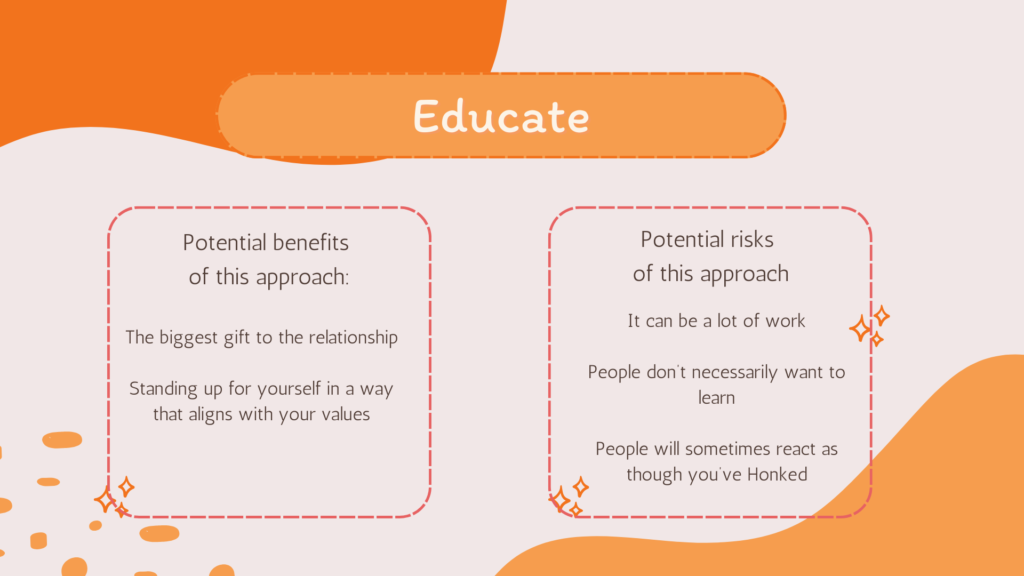
In my opinion “Educate” is the most complicated approach, because it asks that you engage really sincerely with the other person. This is a good example of the concept mentioned earlier, about how boundaries are a gift to our relationships. Even though in the short term this approach is not necessarily super comfortable, in the long term it helps the relationship become an environment that both of you can feel good in — and that’s an incredible gift to give to both of you.

Best used with: relationships that you care about and want to deepen.

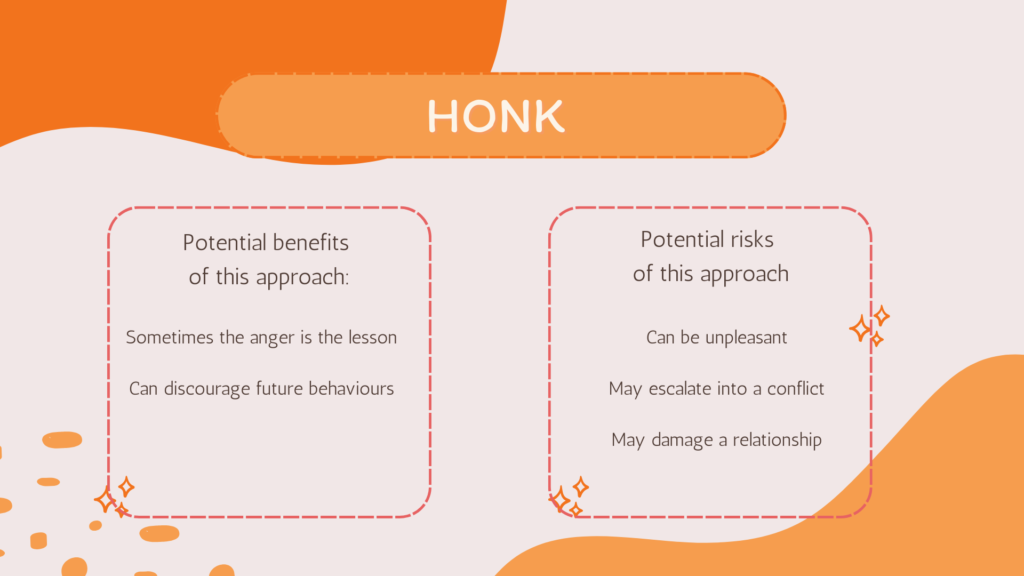
Let’s go back to the driving metaphor. Honking can serve a handful of different purposes. We usually think of it just as a way of saying “Hey! F*** you!” But it can also be a way of trying to communicate information that you have no other way of communicating. “You’re coming into my lane!” “Pay attention!” “Stop it!” Honking can serve similar purposes in our relationships. I definitely think there’s a time and place for honking, but I think it’s kind to our relationships to try different approaches first. But, like with driving, you need to assess the current situation and respond accordingly.

Best used with: careful consideration, after other approaches have not worked.


I would love to expand on the above approaches, but this piece is already getting kind of long. Brevity is not generally my strong suit. So instead let’s look at what these approaches might look like in practice. As a heads up (or a content/trigger warning), I’ve used some specific examples of diet talk below. I’m hoping these situations are specific enough to be useful, but generic enough to be generalizable to your life. They’re certainly not designed to be triggering, but diet culture is a tricky beast and so if you notice that you’re feeling triggered, feel free to take some space. This blog post isn’t going anywhere babe! You can come back to it a different day!

You can use these responses verbatim if they work for you, but lots of them probably won’t be a perfect fit. Adapt them as much as you need to. And if you see a response that makes you shudder, that’s okay too — take what’s helpful and leave the rest. 

Situation 1: Hungry Eyes

Your family is together for the holidays. At dinner, your cousin glances over at your plate and says “you’re really eating all of that?”

Swerve: Yep, I am! Anyway, how have your kid’s piano lessons been going?

Educate: I’ve been working hard on my relationship with food, so I’d really appreciate it if you didn’t comment on my food choices. If you want we can talk more about this later, but for now let’s just keep our eyes on our own plates. Thanks! 

Honk: What I’m eating really isn’t any of your business. 

Situation 2: Your Fitness Pal

You’re on the phone with your friend and he starts talking about this new diet and exercise routine that he’s going to try in order to lose “all this extra weight”. 

Swerve: Well, I like you at any size. Anyway, how have things been at work?

Educate: I’ve been learning a lot about diet culture lately, so I’m not really into the diet talk these days. Do you want to hear a little bit about what I’ve learned?

Honk: I love you but I’m not the right person to talk to about this.

Situation 3: Aunt Misbehavin’

Your aunt is staying at your parents’ house for a few days and you come over to visit. At one point in the conversation she lets out a long sigh and says “You have such a pretty face. You’d look so good if you just lost a few pounds.”

Swerve: Anyway, I should get going. It was good seeing you!

Educate: That comment makes me uncomfortable. I’d prefer if you didn’t say anything about my body right now, positive or negative. Thanks!

Honk: What a weird, gross thing to say.


A final pep talk

Setting boundaries is a skill, and skills require practice! It’s normal to feel nervous when you’re new to driving, or when you’re driving in an unfamiliar place or in adverse weather conditions.

Try to remember that there are no perfect answers. Sometimes driving safely means staying off the road in certain conditions, driving slower than other drivers want you to, taking detours or shortcuts, or keeping pace with the flow of traffic even though it’s a different speed than you’d prefer. Sometimes taking care of yourself looks like “picking a fight” and sometimes it looks like “letting yourself get walked all over”. Ultimately it’s not your job to drive in a way that’s convenient to other drivers, it’s your job to drive in a way that you think is safe. Try to show yourself some grace and compassion. You’re doing the best you can. 

Good luck out there — drive safe!

Boundaries (Part One)

Posted by: Lee Thomas

Time to read: 4 minutes


One metaphor I like to use around boundaries is driving. So let’s talk about highway driving for a second.

A key thing about driving is that you only control your own vehicle. You can do basically nothing about how other people drive; all you can do is choose how you drive, and how you respond to their driving. If your plan for a smooth trip is controlling how other people drive, you’re in for a bad time.

We’ve got these lines painted on the highway. And the thing is, those lines actually do nothing to prevent cars from driving over them. But we’ve all collectively decided that those lines mean something, and the vast majority of the time most of us try really hard to not cross those lines, because we know they keep us safe and other people safe. 

The majority of boundaries we set will hopefully be like these lines. A lot of the time when we start talking about boundaries, our brains immediately jump to “well what if the person doesn’t respect those boundaries???” And I get it, because a lot of the time we’re coming into these conversations with experiences of people not caring about our boundaries. And we’re going to cover that “what if” a little later on.

But let’s be honest: sometimes we’re so sure that people won’t listen to our boundaries that we don’t even really express them. So let’s remember that on this road, we’ve just got these painted lines, but most people try to follow those lines most of the time. (People don’t follow them nearly as well when they’re impatient or not paying attention or don’t know the rules or think that their desires are more important than others. I’d argue that that’s all basically true for boundaries too). Many people, and hopefully most people in your life, want to treat you relatively well, but they need to see the lines in order to be able to do that.

But also, unfortunately, there’s some moments where the line just doesn’t quite cut it. Back to our highway. We don’t have just one painted line and then a huge plummeting cliff, right? We’ve got the line, and then a rumble strip, and then a shoulder, and then a ditch. I think it can be helpful to think of boundaries in a similar way. We can have layers of boundaries and consequences, it doesn’t have to be an all-or-nothing approach.

The last part of this metaphor is the importance of being proactive. We learn about driving before we get in the car. We do up our seatbelts. We think about the conditions we’re going to be driving in, and we try to set our expectations accordingly. We drive differently in a nighttime winter storm than on a clear sunny day, and that can be true about boundaries too. It’s almost always more effective to set people up for success by communicating needs in advance than it is to set boundaries in the moment… but that’s a blog post for a different day.

This part of the boundaries talk doesn’t translate well into the driving analogy, so I’m just going to say it directly: we don’t live in a very pro-boundary culture. We’re usually taught (implicitly or explicitly) that setting a boundary is harmful to our relationships, that boundaries are something we do as a punishment, and that a healthy relationship should never need conversations about boundaries because the other person should just know how you feel without you ever having to express it. 

But that isn’t true. Boundaries are a gift to our relationships. Setting boundaries sometimes sucks, but that’s actually part of what makes them such a gift. We don’t do things that suck for relationships we don’t care about. And often the more that it sucks and feels awkward and messy, the more of an act of caring it is. It’s way easier to avoid an awkward situation and just cut someone out of your life lol.

Setting boundaries is part of the messy business of learning to care for other people and for ourselves. I feel like this idea is summed up beautifully by this quote from Prentis Hemphill: “Boundaries are the distance at which I can love you and me simultaneously.”

Join our mailing list!

We promise to never spam you or sell your information.
You can unsubscribe at any time.